Research, Technology, and Education for the Geological Storage of Carbon Dioxide (CO₂)
Industrial processes such as the production of cement, iron and steel, and petrochemicals, as well as burning fossil fuels (e.g., gas, oil, and coal) has measurably increased CO₂ in Earth’s atmosphere. The long-term consequences of increased concentrations of CO₂ gas in Earth’s atmosphere will have negative impacts to oceans and climate.
One possible response is to capture CO₂ in industrial settings and reinject it into deep geological reservoirs where it will be retained for long periods of time. This process is called geological sequestration, or carbon capture and storage (CCS).
The Gulf Coast Carbon Center (GCCC) seeks to impact global levels of atmospheric CO₂ by
- Conducting studies, often focusing on the Gulf of Mexico, in regard to geological storage, retention and monitoring of CO₂ in the deep subsurface;
- Educating the public about the process of geological CO₂ storage; and
- Enabling the private sector to develop an economically viable industry to store CO₂ in the Gulf of Mexico, across the U.S., and globally
Since 1999, the GCCC has been a global leader in research that facilitates a proactive response by energy-related businesses to reduce atmospheric release of CO₂. The GCCC has led or is in the process of conducting several major field research projects onshore and offshore to develop effective technologies to monitor retention of CO₂ in the subsurface. In addition, the GCCC has led a number of diverse projects including estimation of storage capacity, enhanced oil recovery (EOR) screening and economic assessments, risk and monitoring of leakage to water and surface resources, assessment of pressure, and whole-system integration.
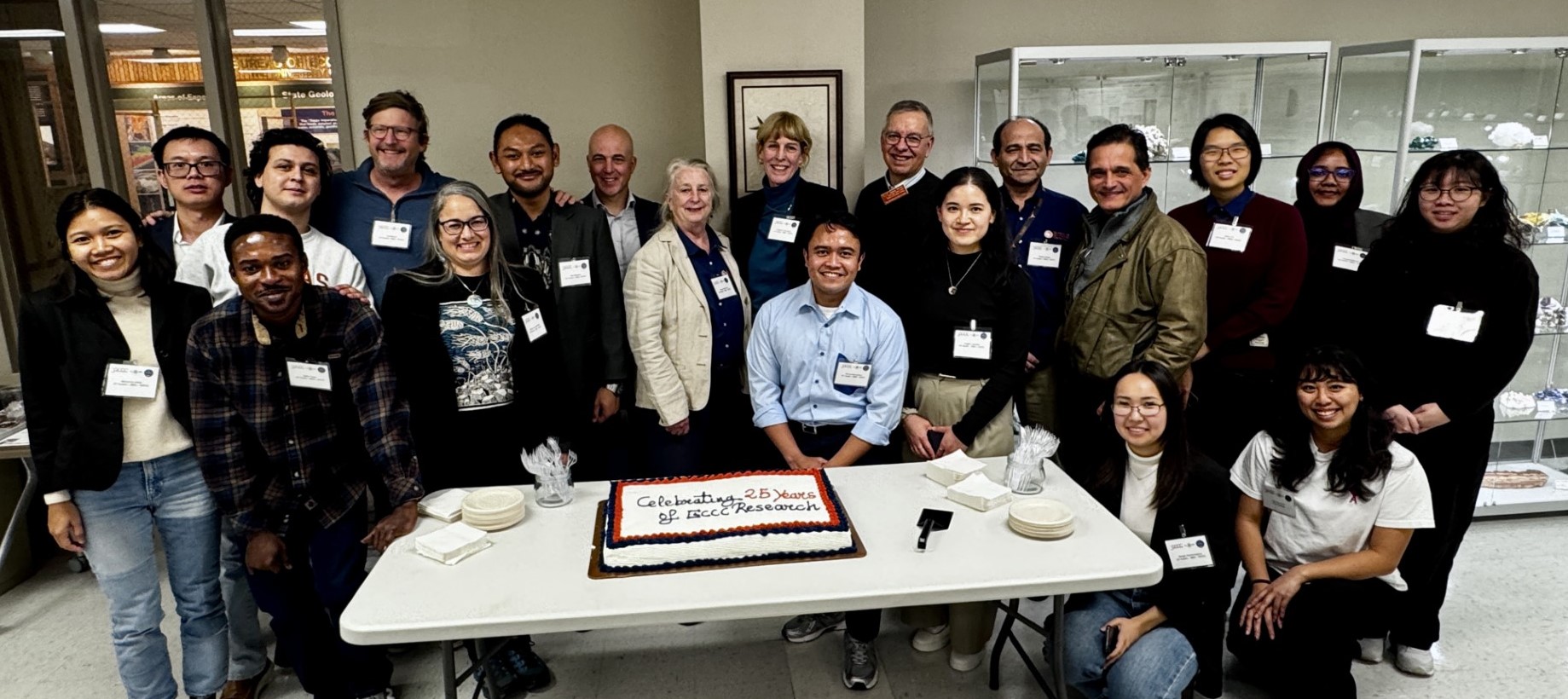
The GCCC is a multidisciplinary group that includes experts in geology, hydrology, petroleum engineering, chemistry, economics, and computer modeling. For more information about the researchers, post-docs, and students who comprise the Carbon Center, please see our staff page.
Recent News
August 17–20, 2026: Please be sure to catch the Gulf Coast Carbon Center’s representatives Dolores van der Kolk and Carlos Uroza at the SEG-AAPG-SEPM IMAGE Conference…click to read
July 31, 2026: For the GeoFORCE Texas program, the GCCC wraps up having 24 high school seniors who participated in hands-on, carbon storage experiments led by Hailun Ni and Katherine Romanak…click to read
July 30, 2026: The Bureau of Economic Geology featured Alex Bump and the GCCC’s research on Composite Confining Systems in their online news…click to read
July 29, 2026: UT Austin’s Gulf Coast Carbon Center and IEAGHG released the final technical report for the 8th International Workshop on Offshore Geologic CO₂ storage…click to read
July 23, 2026: Sue Hovorka and Dolores van der Kolk met with a representative from the American Petroleum Institute (API) …click to read
July 20–23, 2026: Angela Luciano attended the National Association of Geoscience Teachers’ (NAGTs’) Earth Educators’ Rendezvous in Columbia, South Carolina to present a poster about CCS education and to participate in Share-a-thon activities…click to read
July 10, 2026: Congratulations to Seyyed Abolfazl Hosseini, Jungang Chen and their co-authors for their manuscript entitled, "A decade of progress in the modeling and simulation of geologic carbon storage"…click to read
July 9, 2026: Congratulations to the GCCC’s Alex Bump and PGE’s Nicolas Espinoza for their paper, “Are the Fears Justified? Observations of Gulf Coast Fault Seal and Implications for CCS,” which was awarded “Best Oral Presentation” from the CCUS 2026 Conference this year…click to read
July 7, 2026: Hailun Ni kicked off a HornRaiser campaign at The University of Texas at Austin to raise $2,000 to build a portable mini sand tank kit — to bring hands-on carbon storage science experiments out of the Sandtank lab and into classrooms across Texas…click to read
July 1, 2026: Check out Sue Hovorka’s new publication entitled, Evolution of storage monitoring – update in response to commercial and regulatory drivers…click to read
July 1, 2026: Congratulations to Jungang Chen and Seyyed Hosseini for publishing a manuscript in the International Journal of Greenhouse Gas Control…click to read
June 28 –July 4, 2026: The GCCC’s Katherine Romanak was an instructor discussed CCS monitoring and environmental impact at IEAGHG’s CCS Summer School held in Copenhagen, Denmark…click to read
June 5, 2026: Thanks to 1PointFive for hosting the GCCC’s Sponsors’ Meeting at the Ion District…click to read
June 2, 2026: GCCC’s Alex Bump presents, “The State of Gulf Coast Carbon Capture & Storage (CCS)” at the “Offshore CCS & New Frontiers” meeting at Rice University…click to read
May 30, 2026: The GCCC welcomes Uzoma Ajugwe who is entering a second year in the Petroleum and Geosystems Engineering Ph.D. program at The University of Texas at Austin…click to read
May 18, 2026: The GCCC celebrated Ramón H. Treviño who retires at the end of May…click to read
May 15, 2026: Katherine Romanak was selected as a Lead Author for the upcoming 2027 IPCC Methodology Report on Carbon Dioxide Removal Technologies, Carbon Capture, Utilization, and Storage for National Greenhouse Gas Inventories…click to read
May 8, 2026: We are particularly proud of our students from the Gulf Coast Carbon Center who graduated today…click to read
May 1, 2026: Ramón Treviño was featured in the Bureau of Economic Geology’s "Meet a Geoscientist" series…click to watch
Click here to view 2026 news and events.
En español: la información de almacenamiento geológico de carbono
The University of Texas at Austin is proud to be associated with BP’s sponsorship of the GCCC, an activity accredited by BP’s Advancing Low Carbon program.