2023 Joint Annual GoMCarb – SECARB Offshore Partnerships Meeting
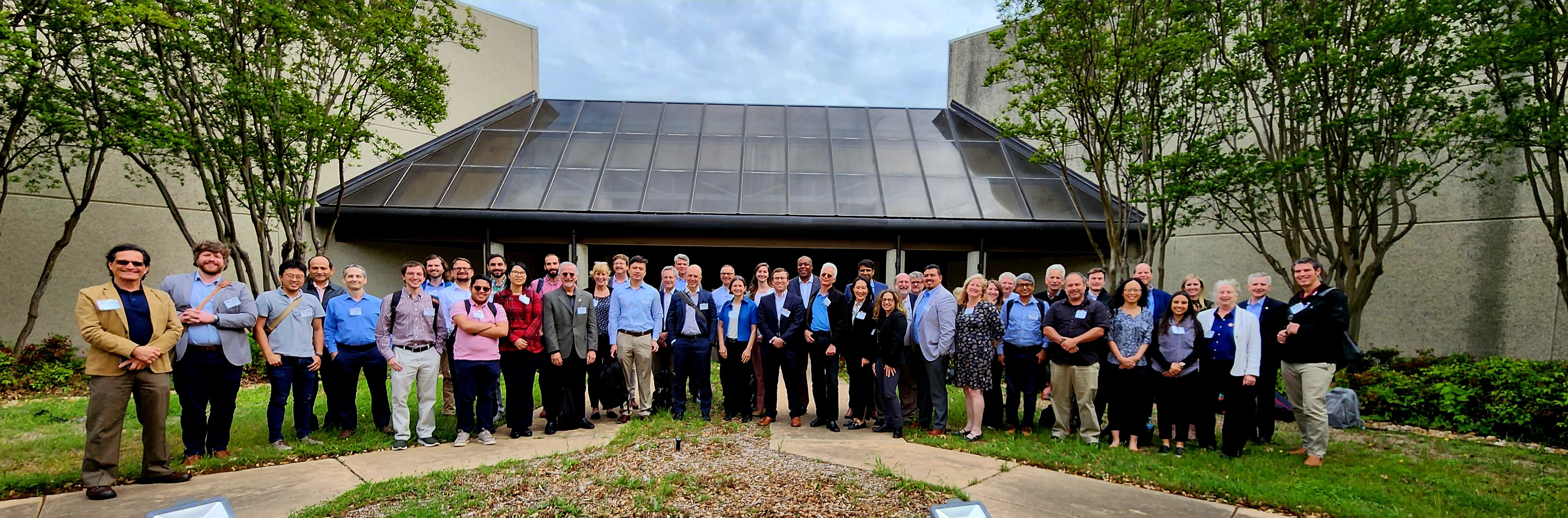
A group of attendees, after the meeting on April 5th, that were headed to the networking event at the Austin Core Research Center.
Wednesday, April 5th, 2023
8:00 – 9:00 AM Registration, Coffee, & Continental Breakfast
9:00 – 9:10 AM Welcome, Safety Briefing & Overview of Day (Sue Hovorka from UT,
Ben Wernette from SSEB)
9:10 – 10:30 AM Session 1 – Outreach and EEEJ – Chair: Ben Wernette
1.1 Incorporating EEJ into Offshore Outreach – Denise Hills, ARI
1.2 State of expectation on CCS Societal Considerations & Impacts: Enabling business offshore Gulf of Mexico – Ramon Gil-Egui, UT
1.3 GoM Stakeholder Outreach Survey – Katherine Romanak, UT
1.4 Training a new generation of subsurface CCS professionals – Alex Bump, UT
1.5 Review of recent GCCC Publications relevant to offshore – Hailun Ni, UT
10:30 – 10:45 AM Break
10:45 – 11:45 AM Session 2 – Regulatory and Legislative – Chair: Katherine Romanak, UT
2.1 Legislation Update – Tip Meckel, UT
2.2 International Offshore Workshop Report– Katherine Romanak, UT
2.3 Lessons from the London Protocol – Tim Dixon, IEAGHG
2.4 Offshore Permitting in Europe – Ingvild Ombudstvedt, IOM Law (virtual)
11:45 AM – 1:30 PM Lunch & Poster Session
1:30 – 2:55 PM Session 3 – Infrastructure – Chair: Ramon Trevino, UT
3.1 Impact of CO2 Impurities on Corrosion of Infrastructure Transporting and Injecting Dense Phase CO2 –
Jose Vera, DNV (presentation not available at this time)
3.2 Infrastructure variability on transects – Darshan Sachde, Trimeric (presentation not available at this time)
3.3 Modeling and Infrastructure Considerations for the Horn Mountain Field – Ann Oudinot, ARI
3.4 Subseabed system for CO2 injection into Horn Mountain – Kjartan Pedersen, Aker (virtual)
3.5 Development Case Studies for Offshore CO2 Storage and EOR in the GoM – Angus Marshall, Storegga
2:55 – 3:10 PM Break
3:10 – 4:15 PM Session 4 Characterization & Assessment of Storage Opportunities – Project Progress –
Chair: Tip Meckel
4.1 Offshore overview news: Who is doing what, where – Tip Meckel, UT
4.2 Lochridge projects (CarbonSafe Phase II) – Laszlo Benkovics, Repsol (presentation not available at this time)
4.3 Bayou Bend – Lianne Armpriester, Chevron (presentation not available at this time)
4.4 Port of Corpus Christi CarbonSAFE Phase II – Tip Meckel, UT
4:30 PM Day ends
4:30 – 6:00 PM Networking Reception
Thursday, April 6th, 2023
8:00 – 9:00 AM Registration, Coffee, & Continental Breakfast
9:00 – 11:30 AM Session 5 Monitoring & Risk; Chair: Dave Riestenberg, ARI
5.1 Minimizing exposure to legacy wells – Alex Bump, UT
5.2 Assessing wellbore integrity risk in the Gulf of Mexico for Potential CO2 storage applications in depleted fields –
Brigitte Petras, Battelle (virtual)
5.3 Presentation cancelled
5.4 Woolsey Mound, Carbon Storage and Risk Assessment – Camelia Knapp, OSU (virtual)
10:00 – 10:15 AM Break
5.5 Towards integrated seismic MVA for near-shore GCS: Characterizing passive acoustic emissions from seafloor gas leakage
using DAS – Jonathan Ajo- Franklin, Rice Univ. (virtual) (presentation not available at this time)
5.6 High-resolution 3D (HR3D) seismic – Tip Meckel, UT
5.7 New Developments in CSEEP Attribution Method – Abdirahman Omar, Norce
5.8 Environmental MVA for the GoM – Katherine Romanak, UT
5.9 Coupled Wellbore-Reservoir Modeling to Evaluate CO2 Injection Rate Distribution Over Multilayer Storage Zones –
Mohamed Abdelaal, LSU (virtual)
11:30 AM – 1:30 PM Lunch & Poster Session
1:30 – 4:30 PM Session 6 Characterization & Assessment of Storage Opportunities –
Chair: George Koperna, ARI
6.1 Pressure space, capacity maps and achievable storage volumes – Alex Bump, UT
6.2 Reservoir Properties and Storage Resource in the Central Gulf of Mexico – Jack Pashin, OSU (virtual)
6.3 Atlantic CCS Assessment: An Introduction & Status Update – Dominic Smith, BOEM
6.4 Sandbox model results & implications for CO2 migration and trapping – Hailun Ni
6.5 Ripple-lamination, Sandbox Experiments – Jose Ubillus UT
6.6 Chandeleur Canyon, LA – Marcy Purkey Phillips, UT (presentation not available at this time)
2:55 – 3:10 PM Break
6.7 Chandeleur Sound, Louisiana – Yushan Li, UT
6.8 Capillary Pressure Measurements using Real Rock Micromodels – Shadya Taleb Restrepo, UT
6.9 Micromodels – Richard Larson, UT
6.10 On the impacts of reservoir heterogeneity for CO2 in an offshore saline reservoir – Ryan Pollyea, Virginia Tech
6.11 Large-Scale Subsurface Models – Reinaldo Sabbagh Maciel, UT
6.12 Injection boundaries: observations from hydrocarbon production and aquifer support offshore Corpus Christi –
Chinemerem Okezie, UT
6.13 Offshore Pliocene – Ismail Faruqi, UT
6.14 Reservoir compartmentalization and its impact on storage project scale, offshore Corpus Christi – Charlie Zheng, UT
4:30 PM Day Ends After Closing Remarks
Friday, April 7th, 2023
8:00 – 9:00 AM Continental Breakfast & Coffee
9:00 – 10:20 AM Session 7 Automation, Machine Learning, & Data Management –
Chair: Seyyed Hossieni, UT
7.1 BEG SMART Project – Hongsheng Wang, UT
7.2 Data analytics on BOEM dataset – Tim Leng, UT
7.3 Predicting CO2 solubility in Crude Oil with Data-Driven Machine Learning Models – Rupom Bhattacherjee, OSU (virtual)
7.4 NETL EDX group – Kelly Rose, DOE NETL
7.5 3-D CFD Modeling of Subsea CO2 Pipeline Leaks – Vinayak Rajan, Lamar Univ.
10:20 – 10:30 AM Break
10:30 –11:00 AM Closing Remarks by Benjamin Wernette (SSEB) and Susan Hovorka (UT)
Posters – In the Atrium at the Commons Conference Center
- Where are you on CCS? – Dolores van der Kolk, UT
- Overview of the SECARB Offshore Program – Ben Wernette, SSEB (presentation not available at this time)
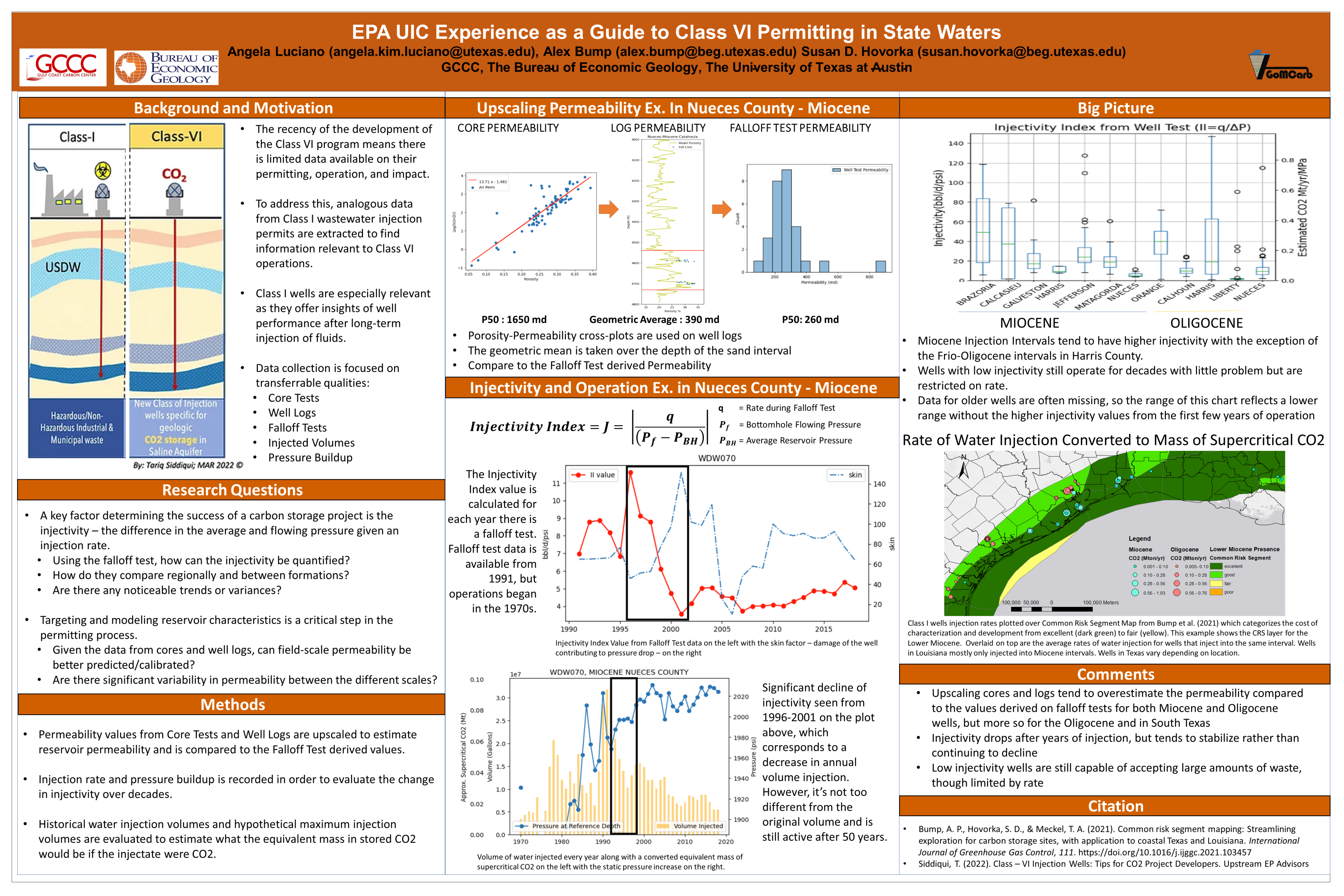
- EPA UIC Experience as a Guide to Class VI Permitting in State Waters – Angela Luciano, UT
- CO2 Storage: Reinventing Petroleum Geoscience for New Applications – Alex Bump, UT
- CCS – SCI: Enabling Business in the Gulf of Mexico – Ramon Gil-Egui, UT
- Sand Tank Experiments – Jose Ubillus, UT
- Regional mapping of confining zones (Anahuac and Amphistegina B) – Tucker Hentz, UT
- A seismic-based CO2-sequestration regional assessment of the Miocene section, Gulf of Mexico, Texas and Louisiana –
Michael DeAngelo, UT - Deep Saline Reservoir Modeling – Lars Koehn, Virginia Tech (presentation not available at this time)
- Regulatory Workflow for Offshore Permitting – Brian Snyder, LSU (presentation not available at this time)
.jpg)